A Practical Look at Letter and Number Tracing Book V-6: Who It Serves and How It Compares
When you start exploring early learning resources for handwriting development, the sheer number of options can feel disorienting. Tracing books, in particular, come in dozens of formats, each making slightly different promises about what they offer. Letter and Number Tracing Book V-6 sits in a specific category: a comprehensive, print-ready activity book that covers uppercase letters, lowercase letters, numbers, and shapes within a single 115-page volume. Understanding where it fits—and where it doesn't—helps clarify whether it matches what you're actually looking for.
This article examines what Letter and Number Tracing Book V-6 actually contains, how it compares with other approaches to early writing practice, and what tradeoffs come with choosing a bundled resource over more specialized alternatives. The goal isn't to steer you toward one answer, but to give you a clearer framework for evaluating your options.
What Exactly Is Letter and Number Tracing Book V-6?
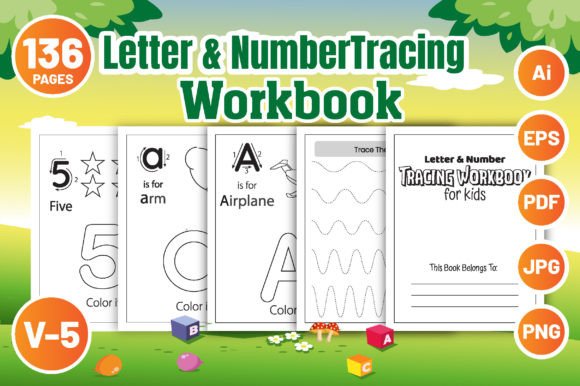
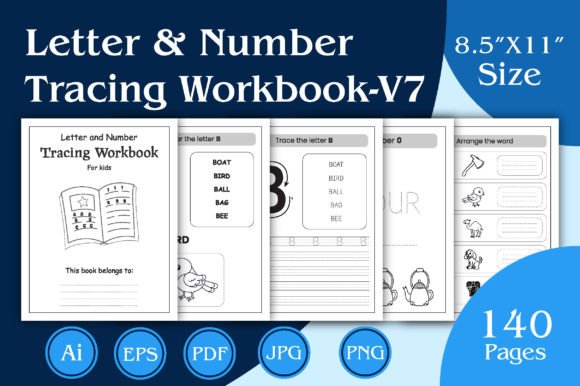
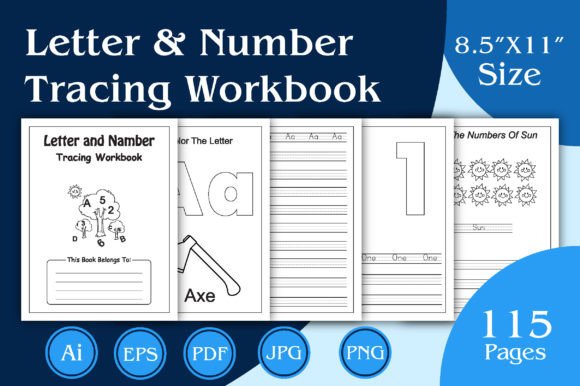
At its core, this is an activity book designed for young learners who are beginning to develop fine motor control and letter recognition. It covers four distinct areas: uppercase letter tracing from A through Z, lowercase letter tracing from a through z, number tracing for digits 0 through 9, and shape tracing. The book spans 115 pages in an 8.5 by 11-inch format with no bleed, which means it's optimized for standard home or classroom printing.
One aspect that sets Letter and Number Tracing Book V-6 apart from many off-the-shelf tracing books is its delivery format. Rather than receiving a physical bound book, you get a downloadable package containing multiple file types: a fully editable AI file, an editable EPS file, plus PNG, JPG, and PDF versions. For anyone who needs to print pages selectively, customize content, or integrate the material into a larger curriculum, this multi-format approach offers a level of flexibility that pre-printed workbooks simply cannot match.
Evaluating the Four Content Areas: What You Gain and Where Gaps May Exist
Each section of the book serves a distinct developmental purpose, but the depth of coverage varies. Understanding those variations helps set realistic expectations.
Uppercase Letter Tracing
Uppercase letters are generally the starting point for most handwriting programs because they involve simpler, more distinct strokes. The A-Z coverage here provides structured repetition, which matters for building muscle memory. Children get multiple exposures to each letter form, and the large 8.5 by 11-inch pages give ample room for early attempts that are typically large and unsteady.
What this section does well is provide consistency. Each letter follows the same presentation approach, which reduces cognitive load for a child who is still learning what letters even are. The tradeoff is that this uniformity may not suit every learner. Some children benefit from varied approaches—tracing in sand, forming letters with play dough, or using apps that provide animated stroke guidance. Letter and Number Tracing Book V-6 stays firmly in the pencil-and-paper domain, which works beautifully for some families and feels limiting for others.
Lowercase Letter Tracing
Moving from uppercase to lowercase introduces more nuanced curves and connections. The lowercase section mirrors the uppercase format, which creates a predictable learning experience. For children who thrive on routine, this consistency across sections is a genuine strength—they know what to expect when they turn the page.
One consideration here involves letter grouping. Some alternative tracing resources group letters by stroke type—letters with circles, letters with straight lines, letters with diagonal strokes—rather than going sequentially from a to z. Letter and Number Tracing Book V-6 follows the alphabetical sequence, which may or may not align with your preferred teaching approach. Neither method is universally better; the sequential approach simplifies organization and helps children learn alphabetical order, while stroke-based grouping can accelerate handwriting fluency for certain learners.
Number Tracing 0-9
The number section covers digits 0 through 9, giving children practice with numeral formation. This is straightforward and functional. For many parents and educators, the inclusion of numbers alongside letters eliminates the need to purchase a separate number-writing resource, which adds convenience and reduces overall cost.
A nuanced point worth noting is that this section focuses on digit formation rather than number sense. Children learn to write the symbol "7," but the book doesn't connect that symbol to quantity concepts. If you're looking for a resource that simultaneously builds handwriting skills and math readiness, you may want to pair this book with activities that reinforce counting, one-to-one correspondence, and quantity recognition.
Shape Tracing
Shape tracing often gets overlooked in discussions about early writing, but it plays an important role in developing the fine motor control and visual discrimination that eventually support letter formation. Circles, squares, triangles, and other basic shapes require children to control their pencil through curves and angles—the same fundamental movements they'll need for writing letters like o, d, p, or k.
The inclusion of shape tracing in Letter and Number Tracing Book V-6 represents a thoughtful design choice. It gives children a low-pressure entry point before they tackle the more cognitively demanding task of forming letters. For learners who feel anxious about "getting letters right," starting with shapes can build confidence and pencil control without the added weight of literacy expectations.
How the Multi-Format Delivery Changes What You Can Do
The downloadable nature of this resource deserves closer attention because it fundamentally changes how you can use the material. When you buy a physical workbook, you get one copy that degrades with use. With the file package included in Letter and Number Tracing Book V-6, you receive editable AI and EPS source files alongside ready-to-print PNG, JPG, and PDF versions.
This means you can print the same page repeatedly for a child who needs extra practice with a particular letter. You can also modify the source files if you want to adjust line weights, add arrows indicating stroke direction, or translate instructions into another language. For teachers building differentiated materials for a classroom, this customizability can be significant. For a parent who simply wants to print and go, the ready-to-use PDF serves that need without requiring any design software knowledge.
The 115-page count and no-bleed format also mean the book is optimized for standard printers. Pages print cleanly without requiring trimming, which saves time and frustration. This practical consideration matters more than it might seem—resources that require special paper handling or post-printing trimming often end up underused simply because the process feels cumbersome.
Comparing Formats: Printable Files Versus Physical Workbooks
The choice between a downloadable tracing resource and a physical workbook reflects different priorities. Physical workbooks arrive ready to use. You open the cover and hand it to a child. They're tangible, collectible, and often include motivational elements like completion certificates or sticker pages. The binding keeps pages organized, and the book feels like a cohesive product.
Letter and Number Tracing Book V-6 takes a different path. As a printable resource, it offers indefinite reusability. You can print pages for multiple children across several years. You can select only the pages you need rather than working through a predetermined sequence. You can print on different paper types—heavier stock for paint or marker use, regular paper for pencil, or even cardstock for pages you want to laminate and use with dry-erase markers.
The tradeoff is that you take on the printing work yourself. You need a reliable printer, paper, and ink. Over the course of 115 pages, those costs add up. For some households, the math still favors printables; for others, a physical workbook purchased on sale may prove more economical. Neither choice is universally superior—it depends on how many children will use the resource, how often you'll reuse it, and what printing resources you already have available.
Who Tends to Benefit Most from This Resource?
Based on the structure and features, Letter and Number Tracing Book V-6 generally aligns well with several specific use cases.
Homeschooling parents who teach multiple children across different ages often appreciate the reusability factor. Printing the same letter pages for a younger sibling two years later eliminates the need to repurchase materials. The editable source files also let parents adapt content to fit their specific teaching philosophy or sequence.
Early childhood educators and daycare providers working with groups of children benefit from the unlimited printing capability. They can produce class sets, create take-home practice packets, or print select pages for targeted intervention with students who need extra support with particular letter formations.
KDP publishers and content creators represent another audience entirely. Because the download includes fully editable AI and EPS files, this resource can serve as a template or starting point for creating derivative works, assuming appropriate licensing. The ready-for-print formatting saves considerable setup time for those familiar with publishing workflows.
Occupational therapists who work with children on fine motor delays may find the clean, uncluttered page layouts useful. The absence of distracting illustrations keeps attention on the tracing task itself, which can be helpful for children who are easily overstimulated by busy workbook pages.
Where the Resource May Not Be the Best Fit
Every resource has limitations, and acknowledging them helps you make a clearer decision. Letter and Number Tracing Book V-6 doesn't include phonics instruction, letter-sound correspondence, or word-building activities. It focuses specifically on letter formation. If you're looking for an integrated literacy resource that teaches handwriting alongside reading readiness, you'll likely need to supplement with additional materials.
The book also doesn't incorporate sensory or multi-modal approaches to letter learning. Children who learn best through tactile experiences, movement, or auditory reinforcement won't find those modalities represented here. The resource works within the traditional worksheet paradigm, which serves many learners effectively but doesn't address every learning style.
Additionally, while the 115-page count sounds substantial, that span covers all four content areas. Distributing those pages across uppercase letters, lowercase letters, numbers, and shapes means each individual letter or number receives a limited number of practice pages. For a child who needs extensive repetition with specific letters—a common scenario for letters that are developmentally harder to form, like lowercase g or k—you may want a resource that provides more focused practice per letter.
Key Decision Factors When Choosing a Tracing Resource
When you're evaluating whether Letter and Number Tracing Book V-6 or any similar resource fits your needs, several factors tend to matter most in practice.
Printing capacity and cost tolerance come first. If you don't own a reliable printer or can't comfortably absorb ink and paper expenses for 115 pages, a physical workbook may serve you better. If you already print regularly and have a cost-effective setup, the reusability advantage of a printable resource becomes more meaningful.
Customization needs represent another filter. Do you need to modify content, add translations, adjust instructions, or extract individual pages for targeted use? The editable file formats included with this book directly address those needs. If you'd never open an AI or EPS file, that feature still adds value through the ready-to-use PDF and image formats, but you won't fully leverage what makes this particular product distinct.
Scope of learning goals matters as well. If handwriting formation is your sole focus right now, the concentrated practice this book provides fits neatly. If you're building a broader early literacy program, consider this one component among several you'll need to assemble.
Practical Example: Comparing Usage Scenarios
Imagine two different families. Family A has a four-year-old who is ready to start learning letter formation. They have a color printer, a laminator, and two younger children who will eventually need the same materials. They prefer reusable resources and don't mind some assembly. For Family A, Letter and Number Tracing Book V-6 makes practical sense—they can print, laminate, and reuse pages across multiple children over several years, and the one-time download cost spreads across that extended use.
Family B has a five-year-old who is their only child. They don't own a printer and prefer grab-and-go solutions. They're also interested in a resource that connects handwriting practice with beginning reading skills. For Family B, a physical workbook with integrated phonics content might align better with their circumstances, even though it means they can't reuse pages.
Neither family is making a wrong choice. They're simply evaluating the same product through the lens of their specific constraints and priorities.
Making Sense of What's Included and What Isn't
Letter and Number Tracing Book V-6 delivers a focused, well-organized set of tracing activities across four relevant skill areas, packaged in a way that emphasizes flexibility and reusability. The inclusion of editable source files distinguishes it from many printable tracing resources that only provide locked PDFs. The 8.5 by 11-inch no-bleed format keeps printing straightforward.
What it doesn't provide is equally important to recognize: no built-in phonics, no sensory learning components, no spiral binding or physical product, and a per-letter page count that may or may not meet your repetition needs. These aren't flaws—they're design choices that make the resource well-suited to some situations and less suited to others.
The most useful question to ask isn't whether this is a good tracing book in the abstract, but whether its specific combination of content, format, and flexibility matches what you're actually trying to accomplish. Answering that honestly will lead you to the right choice, whether that's Letter and Number Tracing Book V-6 or something else entirely.