Modern and Minimal Savings Planner for Clear Finances
It is easy to feel overwhelmed by financial information these days. Spreadsheets grow too complex, banking apps provide endless scrolling transaction lists, and multiple accounts fragment your attention. A Modern and Minimal Savings Planner offers a refreshing counterpoint. Instead of adding another layer of digital noise, it strips financial tracking back to its essentials. What you get is a focused, intentional space where numbers become a story of progress rather than a source of stress. For professionals, creators, freelancers, and small business owners who already juggle countless decisions, this kind of clarity can feel like a mental reset.
Why a Minimalist Approach Transforms Saving Habits
Conventional budgeting tools often try to do everything. They track expenses, categorize purchases, link to investment accounts, send alerts, and generate color-coded charts. While useful for some, this abundance can paralyze people who only need a clear visual of where their savings stand. A Modern and Minimal Savings Planner bypasses feature overload. It treats saving as its own distinct practice, not a byproduct of expense tracking. When you sit down with the planner, your only job is to log progress, review targets, and make small adjustments. This zeroes in on the behavior that actually builds wealth: consistent, mindful attention to your reserves.
Practical Ways to Use Your Savings Planner Every Week
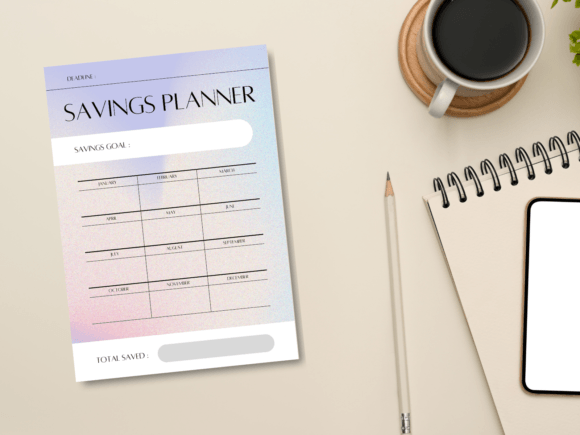
The format of this planner—delivered as both a PDF File and a PNG File at a trim size of 8.5 x 11 inches—gives you enormous flexibility. You can print a fresh sheet each month and keep it on your desk, use it as a digital layer in your favorite note-taking app, or even import the PNG into a graphic design tool and customize it for a specific project. The printable size is standard for North American binders and planners, so it integrates seamlessly with other office materials you already own.
Tracking Irregular Income as a Freelancer
Freelancers, creatives, and entrepreneurs rarely receive the same paycheck twice. This makes conventional monthly budgeting templates feel restrictive. With the Modern and Minimal Savings Planner, you can log deposits as they come and immediately assign them to savings categories without being boxed into rigid income expectations. For instance, after receiving a project payment, you might note the amount in the income column, split it across an emergency fund, tax reserve, and equipment upgrade goal, and see in real-time how close you are to each target. The minimalist layout prevents the sheet from feeling chaotic, even when your income flow is unpredictable.
Planning for a Specific Financial Goal
Maintaining a Joint Household Vision
The Digital and Printable Flexibility You Actually Need
One of the most practical features of this planner collection is the dual file format delivery. The PDF File retains perfect formatting when printed, making it ideal for those who prefer a tangible paper trail. You can print it as many times as you need, for as many months or years as you wish. The PNG File adds a layer of creative freedom. Use it as a background in a digital planning app like GoodNotes, Notability, or OneNote, where you can write directly with a stylus. Or drop it into a Canva template and add your own color accents, logos, or custom headings to match your brand if you are a coach or content creator sharing templates with an audience.
The 8.5 x 11 inches document size deserves special mention because it respects your real-world workflow. It fits standard printers, standard binders, and standard desk organizers. There is no frustrating trimming, no awkward margin adjustments. If you like to keep a physical archive of your financial journey, these sheets will slide into any three-ring binder and sit neatly alongside tax documents or business receipts. This may seem like a small detail, but in practice, it removes friction every single time you decide to sit down and plan.
Who Benefits Most from a Dedicated Savings Tool?
Busy professionals and executives often have their financial lives fragmented across multiple institutions. A single-page savings tracker serves as a dashboard that cuts through the noise, showing only the numbers you have intentionally decided to watch. Marketers and bloggers with fluctuating campaign-based income can use the planner to smooth out feast-and-famine cycles by visualizing how much they need to set aside during high-earning months. Small business owners who already use accounting software may still benefit from a separate, distraction-free space to monitor personal savings goals, keeping business and personal money psychologically separate.
Educators and researchers often appreciate the clean, no-nonsense design because it mirrors the academic habit of keeping a focused lab notebook. There is a quiet satisfaction in maintaining a record that is thorough yet uncluttered. Hobbyists who are turning passions into side income—a photographer buying new lenses, a woodworker investing in better tools—find the granular tracking helpful for justifying reinvestment decisions. Instead of guessing whether the hobby is self-sustaining, they can see exactly how much they have earmarked and how much they have spent.
When a Simple Planner May Not Be Enough
No tool suits every person in every situation, and it is worth being honest about where a minimal savings planner fits best. If you need real-time synchronization across family members with automatic bank feeds, a dedicated budgeting app like YNAB or a spreadsheet with live formulas may serve you better. The Modern and Minimal Savings Planner is, by design, a manual and intentional tool. It asks for your presence and attention. For someone who feels too time-starved to spare five minutes a week, or who strongly prefers full automation, this might feel like an unnecessary step rather than a mindful ritual.
Making the Most of Your Financial Tracker
To draw maximum benefit from the Modern and Minimal Savings Planner, anchor it to an existing ritual. Pair the weekly update with your Sunday morning coffee, or review it right after your team stand-up meeting on Monday. Consistency matters more than the specific day. When you first start, resist the urge to create too many savings categories. Three to five clear, meaningful goals will keep the page clean and your motivation high. As one goal completes, you can add another. This cyclical rhythm mirrors the planner’s own visual simplicity: always clear, never cramped.