Bullet Journal Weekly Planner: Designing Clarity in an Age of Constant Distraction
In a world where notifications arrive faster than thoughts can settle, the act of putting pen to paper has become unexpectedly radical. The Bullet Journal Weekly Planner isn't merely a scheduling tool — it's a deliberate pause button, a canvas for intentional living that has quietly reshaped how professionals, creators, and entrepreneurs approach their most finite resource: time. As digital fatigue deepens and the hunger for tactile, mindful systems grows, the weekly bullet journal format has emerged as both an antidote to chaos and a framework for creative self-direction.
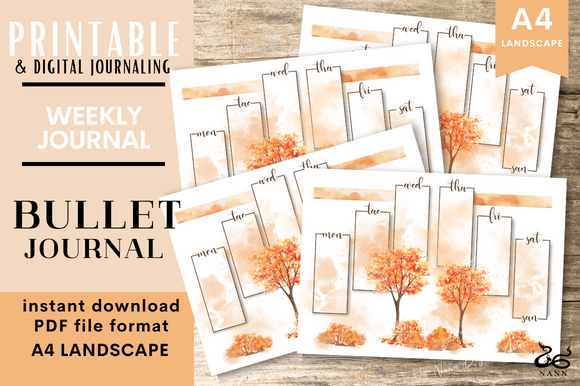
What makes this particular design compelling isn't just its functionality. It's the convergence of practical architecture and publishing-ready polish — a layout crafted explicitly for self-publishers on platforms like Amazon KDP, where speed to market and aesthetic appeal often determine success. Whether printed fresh each week or used as a digital journaling page on a tablet, this A4 landscape spread bridges two worlds that don't often meet: the reflective, analog tradition of bullet journaling and the fast-moving, scalable logic of modern print-on-demand publishing.
What Is a Bullet Journal Weekly Planner — and Why the Format Matters Now
At its core, a Bullet Journal Weekly Planner is a structured yet flexible weekly overview rooted in the bullet journaling method popularised by Ryder Carroll. Unlike a traditional dated planner that dictates where your attention goes, a weekly bullet journal page provides architectural scaffolding — sections for priorities, tasks, notes, habits, and reflections — while leaving ample room for personal interpretation. It's less about filling boxes and more about curating focus.
The weekly spread has become the heartbeat of the bullet journaling practice for a reason. Days can be reactive; months feel abstractly distant. But a week — seven days — is the Goldilocks unit of human productivity. It's long enough to make meaningful progress on a project and short enough to course-correct without spiralling. A well-designed weekly bullet journal page honours that rhythm, giving each day breathing room while keeping the larger arc of the week visible at a glance.
The Landscape Advantage
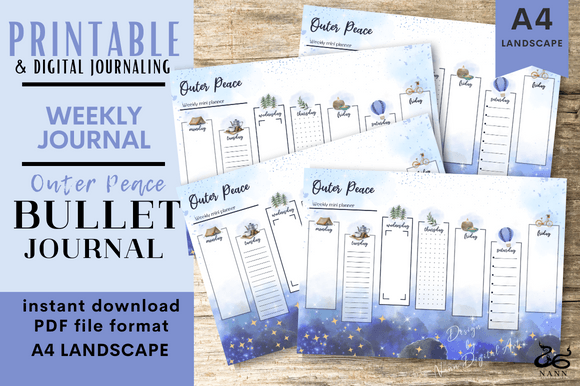
This particular planner adopts an A4 landscape orientation, a choice that deserves more attention than it typically receives. Portrait layouts dominate the stationery market, yet landscape spreads offer a panoramic quality that mirrors how many of us naturally scan information — left to right, horizon to horizon. On a desk, a landscape weekly spread feels expansive rather than cramped. On a screen, it renders beautifully without awkward scrolling. For digital journaling on iPads or Android tablets, the landscape ratio aligns naturally with how devices are held during focused work sessions.
Why People Are Paying Attention to Weekly Planning Again
The resurgence of paper-based planning tools isn't nostalgia — it's a response to genuine cognitive strain. Knowledge workers toggle between applications dozens of times per hour. Notifications fracture attention into fragments too small to build anything meaningful with. In this context, bullet journal weekly planners represent something increasingly rare: a single-input, single-output system that doesn't compete for your attention while you're using it.
Neuroscience offers some validation here. The act of handwriting engages motor cortex regions associated with memory encoding and conceptual processing in ways that typing doesn't replicate. When you manually transfer a task from a chaotic mental list onto a structured weekly spread, you're not just recording information — you're processing it, prioritising it, and committing to it at a neurological level. The planner becomes an extension of working memory, a trusted external scaffold that frees cognitive bandwidth for the work that actually matters.
The Digital Detox Nobody Talks About
Much of the conversation around digital wellness centres on removing technology. But the more nuanced approach — and the one a weekly bullet journal supports — isn't removal; it's relocation. By shifting planning, reflection, and priority-setting onto a physical or semi-physical medium, you create a deliberate boundary between consumption and creation. Your phone becomes a tool you consult, not a taskmaster that dictates your day. The weekly spread becomes a space you visit intentionally, pen in hand, rather than a screen you fall into reactively.
From Personal Practice to Publishing Product: The KDP Connection
Here's where the conversation expands beyond individual productivity and into the creator economy. Platforms like Amazon KDP have democratised publishing, allowing designers, coaches, and entrepreneurs to transform their planning methodologies into tangible products. But the barrier isn't zero — creating a print-ready, aesthetically coherent planner that meets Amazon's technical specifications requires design fluency, file preparation knowledge, and a significant time investment.
This is where a ready-to-use Bullet Journal Weekly Planner template becomes strategically valuable. It arrives as a ZIP file containing a fully formatted PDF — A4 landscape, meticulously structured, tested against KDP's print requirements. For content creators building a planner brand, for coaches developing client resources, or for virtual assistants managing multiple publishing projects, this eliminates the most labour-intensive phase of product development. You're not starting from a blank canvas; you're starting from a publishing-optimised foundation that you can brand, customise, or deploy immediately.
Saving Time Without Sacrificing Quality
The phrase "save time on publishing" can sound like marketing shorthand, but in the context of KDP, it translates to something specific: bypassing the iterative back-and-forth of margin adjustments, bleed settings, and trim size recalibrations that plague first-time publishers. A template that has already resolved these technical considerations means you move from concept to published listing in hours rather than weeks. For entrepreneurs testing multiple niche ideas or building a catalogue of complementary products, that speed is a competitive asset.
How the Weekly Bullet Journal Fits Broader Lifestyle and Business Trends
Zooming out, the appeal of the bullet journal weekly planner aligns with several converging shifts in how people work and live.
1. The Hybrid Work Reality
Remote and hybrid work have blurred the boundaries between professional and personal time. A weekly planner that doesn't rigidly separate "work" from "life" but instead allows them to coexist on the same spread reflects how people actually experience their days. The bullet journal method's emphasis on rapid logging and migration means tasks can flow between contexts without artificial compartmentalisation. What starts as a work priority on Monday might become a personal project by Saturday, and the spread accommodates that fluidity gracefully.
2. The Rise of the Portfolio Career
More professionals now juggle multiple income streams — consulting, content creation, product sales, speaking engagements. Traditional planners built around a single job with predictable hours don't serve this reality. A Bullet Journal Weekly Planner, especially one with open-ended sections and customisable spaces, adapts to whichever combination of roles a person is navigating that week. The same layout that serves a freelancer balancing three clients can support an entrepreneur launching a course while maintaining a day job.
3. The Creator Economy's Need for Repeatable Systems
Creators don't just need inspiration — they need shipping schedules, content calendars, and production workflows. The weekly bullet journal format excels here because it's inherently cyclical. Each week offers a fresh page with the same underlying structure, creating a rhythm of planning, executing, and reviewing that compounds over time. For someone publishing weekly YouTube videos, newsletters, or podcast episodes, this rhythmic predictability is the scaffolding beneath creative output.
Practical Ways Professionals Are Using Weekly Bullet Journal Pages
Beyond the theory, observing how different professionals adapt the weekly spread reveals its versatility.
Freelance designers often use the left side of the landscape spread for client deadlines and project milestones, reserving the right side for creative inspiration, skill development, and personal wellbeing. The visual separation helps maintain focus without requiring two separate planners.
Marketing managers have been known to transform the weekly overview into a campaign tracker, with columns dedicated to content publishing, email sequences, ad performance checks, and team check-ins. The physical act of ticking off campaign stages creates a satisfaction loop that project management software rarely replicates.
Entrepreneurs building KDP businesses use these same weekly pages to manage their own publishing pipelines — outlining new journal concepts, tracking keyword research tasks, scheduling cover design work, and planning promotional activities. There's a pleasing symmetry in using a bullet journal weekly planner to organise the creation and sale of bullet journal weekly planners.
Students and lifelong learners adapt the format to balance coursework deadlines, reading lists, and personal projects, often adding habit trackers for sleep, exercise, and focused study sessions along the bottom edge of the landscape spread.
Digital or Print: Flexibility Built Into the Design
One of the underappreciated strengths of a PDF-based weekly bullet journal page is its medium-agnostic nature. The same file that prints beautifully on heavyweight paper also imports seamlessly into note-taking applications like GoodNotes, Notability, or Samsung Notes. Users who prefer the tactile experience of pen on paper can print a fresh page each week — indefinitely, without ever running out or waiting for a new planner delivery. Those who favour digital annotation can duplicate the page infinitely within their preferred app, building an archive of completed weeks that is searchable, taggable, and accessible across devices.
This dual-use capability matters because planning preferences are rarely static. A person might use a printed spread during a period of intensive, screen-heavy work to give their eyes a rest, then switch to digital journaling during travel when carrying paper becomes impractical. The template accommodates both modes without requiring a change in system or structure — a continuity that preserves the compound benefits of sticking with a single planning methodology over time.
Designing for Clarity in a Noisy Marketplace
For those publishing on Amazon KDP, the aesthetic dimension of a planner is not superficial — it's commercial. Browsers make split-second judgments based on cover art and interior previews. A weekly spread that looks cluttered, inconsistent, or amateurish communicates something about the product's overall quality, fairly or not. The clean A4 landscape design included here addresses this by balancing structure with white space, ensuring that even a quick glance through Amazon's "Look Inside" feature conveys professionalism and usability.
The ZIP file delivery format also reflects a practical understanding of the KDP workflow. Publishers receive the PDF ready for direct upload to the KDP platform — no file conversion, no resolution guesswork, no last-minute margin panic. For those building a brand around productivity, wellness, or creative organisation, this lets the focus remain where it belongs: on audience growth, product positioning, and customer experience rather than technical formatting.
The Quiet Case for Weekly Reflection
Beneath the productivity mechanics, there's something gentler happening in the weekly bullet journal practice. The act of reviewing a completed week — acknowledging what moved forward, what stalled, what was learned — cultivates a reflective self-awareness that pure task management overlooks. In an era that valorises speed and output, the weekly spread creates a sanctioned space for deceleration. Not every empty checkbox is a failure; some are honest signals about capacity, priority, or the unpredictable texture of life.
This reflective dimension is perhaps why the format has endured and expanded beyond the original bullet journaling community. People aren't just looking for better ways to get things done. They're looking for frameworks that help them understand what's worth doing in the first place. A weekly planner, genuinely engaged with, becomes a dialogue between intention and reality — a conversation conducted in ink, week after week, gradually shaping a life that feels more authored than accidental.
Conclusion: A Small Page, a Considerable Impact
The Bullet Journal Weekly Planner — this particular A4 landscape design, delivered as a print-ready PDF within a ZIP file — occupies a unique intersection. It's simultaneously a personal productivity tool and a publishing asset, a weekly ritual anchor and a scalable product foundation. For the professional seeking clarity amid competing demands, it offers structure without rigidity. For the creator or entrepreneur navigating the KDP landscape, it offers a shortcut from concept to market without compromising on quality.
In both cases, the value proposition is the same: less time wrestling with format and more time engaging with content. Whether that content is a week's worth of meaningful tasks or a new product line ready for publication, the page is ready. Print it. Import it. Publish it. The week, as always, is waiting to be shaped.