Evaluating the Teacher Planner Weekly 2023-2024 KDP for Classroom Organization
Selecting the right planning tool can shape how smoothly an academic year unfolds. The Teacher Planner Weekly 2023-2024 KDP enters the conversation as a digital, editable resource designed to consolidate lesson tracking, student records, and personal goal-setting into one structured document. Rather than simply listing its features, this article examines what the planner actually offers in practice, where it excels, and where educators might pause to consider whether its format and scope align with their daily realities.
What the Teacher Planner Weekly 2023-2024 KDP Actually Contains
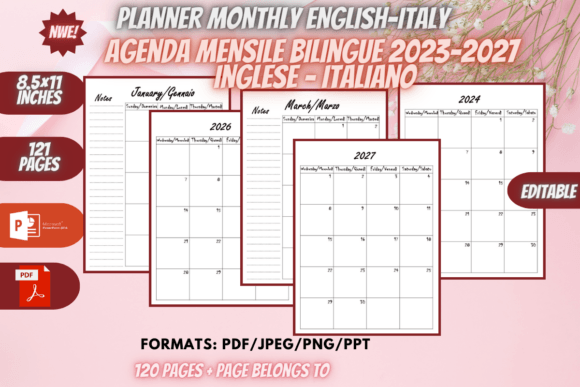
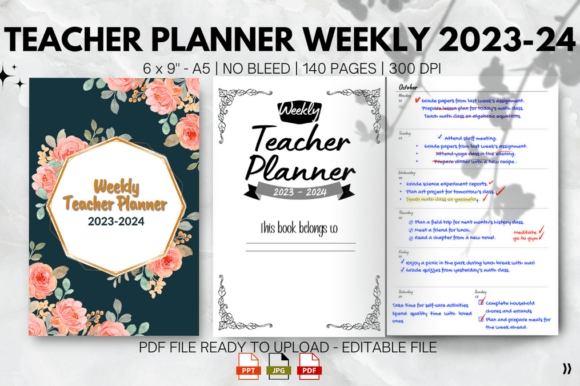
At its core, this is a downloadable, editable planner spanning from August 2023 through June 2024. It arrives as a print PDF file accompanied by an editable PowerPoint version, giving users the ability to type directly into the document before printing or to handwrite entries after printing. The 140-page interior includes a yearly calendar with three months visible at a glance, a weekly planner structured as one week per page, and dedicated sections for attendance, grades, assignment tracking, and parent communication logs. Supporting pages cover yearly goals, important dates, holidays, and student lists, while lined notes pages offer space for unstructured reflections or meeting notes. A set of four cover designs is also included, along with bonus JPG image files at 300 DPI.
What sets this product apart from a static printable is the editable layer. Every section can be modified — headers, table labels, and goal fields can be renamed or restructured. This means a middle school science teacher might adjust the assignment tracker to include lab project phases, while a kindergarten instructor could reshape the parent communication log to emphasize behavioral observations rather than purely academic check-ins. The A5 dimensions (6 x 9 inches) place it between a pocket notebook and a full-size binder, a size that may feel comfortably portable or slightly cramped depending on handwriting size and the amount of detail typically recorded per class period.
Reasons Educators Might Consider This Planner
Teachers often juggle multiple disconnected systems — a gradebook here, sticky notes there, a digital calendar that doesn't always sync with paper records. The Teacher Planner Weekly 2023-2024 KDP attempts to unify these threads. Someone who values having attendance, grades, and lesson notes in one bound volume could find the consolidation genuinely useful. The inclusion of a parent communication log also addresses a real need; documenting calls, emails, and conferences in one place helps maintain continuity, especially when reference is needed weeks or months later.
Another practical draw is cost predictability. Once purchased, the file can be printed and reused as many times as needed for personal use. For educators who prefer fresh planners each year but dislike recurring expenses for pre-printed bound editions, this model offers a different kind of value. The editable PowerPoint file also opens possibilities for those who teach multiple subjects or grade levels — sections can be duplicated, rearranged, or custom-labeled without starting from scratch in a design program.
Practical Benefits Worth Noting
- Structural clarity. The weekly layout distills each week to a single page, which encourages brevity and prevents planning fatigue. For those who feel overwhelmed by sprawling daily spreads, this constraint can be genuinely helpful.
- Customization without design expertise. Because the editable file is in PowerPoint rather than a specialized graphic design format, most users can modify it with tools they already know. This lowers the barrier to tailoring sections for specific classroom setups.
- Portability. The A5 size fits into many teacher bags and desk organizers. It's large enough to write in comfortably for most people but small enough not to dominate a small desk alongside student papers and supplies.
- Bonus covers included. Four cover options provide variety without additional purchase. The JPG files also allow educators to use the planner's aesthetic elements in other personal projects if desired.
- Goal-setting integration. The yearly goals page, while brief, offers a dedicated space for professional or personal objectives, which can help maintain focus beyond daily task lists.
Tradeoffs and Considerations Before Purchase
No planner suits every teaching context, and this one carries specific characteristics worth evaluating honestly. The August-to-June span works well for many Northern Hemisphere school calendars but may feel misaligned for institutions running on year-round schedules or those in regions with different academic year structures. A teacher in Australia or New Zealand, for instance, would likely find the date range awkward and require significant editing to make it functional.
The one-week-per-page format, while clean and focused, may not satisfy educators who need extensive daily breakdowns. A high school teacher managing five distinct course preps with differentiated activities for each class period might find the space insufficient to capture meaningful detail. Similarly, an elementary teacher orchestrating multiple subjects within a self-contained classroom could feel constrained by the weekly summary approach. In these cases, a planner with larger dimensions or daily spreads might reduce frustration and increase actual usage.
Additionally, because this is a digital product for download and editing, the user assumes responsibility for printing and binding. Those who prefer a ready-to-use, coil-bound book delivered to their doorstep should factor in the time, cost, and effort of printing at home or through a service. The 140-page count, while substantial, means a reasonable print job, but the quality of the final product depends heavily on the printer and paper chosen.
The no-bleed design simplifies home printing on standard equipment, which is a thoughtful inclusion. However, the tradeoff is that designs won't extend to the very edge of the page, which some users may perceive as a less polished finish compared to commercially printed planners with full-bleed graphics.
Situations Where This Planner Fits Well
Several teaching scenarios align naturally with what this planner offers. First-year teachers or those transitioning to a new grade level may appreciate the comprehensive yet approachable structure — it provides scaffolding without micromanaging how each section must be used. The parent communication log and assignment tracker, in particular, help establish documentation habits early in a career when those routines matter most.
Homeschooling parents tracking multiple children's progress across subjects could adapt the student list and attendance features to a family learning environment. The editable format allows renaming sections to reflect household needs rather than institutional classroom language. Similarly, itinerant specialists — such as speech-language pathologists, reading interventionists, or music teachers who see different groups across multiple schools — might find the weekly overview format useful, as it encourages efficient session planning without excessive detail that would go unused between sites.
The planner also serves a gifting purpose. A thoughtfully customized version, pre-populated with a colleague's class lists or school holiday dates, can feel personal and practical. The four cover options offer enough variety to match different personalities, and the digital nature means the gift can be given even to someone teaching remotely or in another location.
When Alternatives Might Be Worth Exploring
Educators whose planning style demands extensive daily structure may be better served by a planner with full daily pages, time-blocking layouts, or subject-specific columns. Someone who habitually writes detailed lesson scripts, differentiation notes, and assessment strategies for each day will likely outgrow the one-page weekly format quickly. In such cases, a customizable digital tool like a Google Sheets template or a notion-style database could provide infinite expandability, though at the cost of the tactile satisfaction that a printed planner offers.
Teachers who rely heavily on digital calendar integration — syncing lesson times with Outlook, Google Calendar, or school management platforms — may find a purely paper or PDF approach redundant. If planning information lives primarily in digital spaces and the paper planner becomes a duplicate rather than a primary tool, its utility diminishes. A hybrid approach, perhaps using the Teacher Planner Weekly 2023-2024 KDP solely for attendance, grades, and communication logs while keeping lesson sequencing digital, could bridge this gap, but that requires honest assessment of whether maintaining both systems is sustainable.
Those who value premium paper feel, lay-flat binding, or specific aesthetic finishes should consider that the printing outcome depends entirely on their own equipment or chosen print service. The product itself delivers the design, not the physical object, so expectations around texture and durability rest on the user's printing decisions.
Decision-Making Insights for the Thoughtful Buyer
Before committing, clarifying a few personal preferences and practical constraints can sharpen the decision. Consider the following reflection points, not as a rigid checklist but as a way to gauge alignment:
- How do you currently track attendance, grades, and parent contact? If these functions are scattered across apps, loose papers, and memory, consolidation into one editable document may reduce cognitive overhead. If you already have a functional, integrated system, adding this planner may create redundancy.
- What is your actual writing volume per planning session? Be realistic about how much space you need. The weekly format rewards concise planning; it may frustrate those who write in paragraphs.
- Does the August-to-June timeframe match your work calendar? Editing dates is possible in PowerPoint, but significant restructuring may erode the time-saving advantage that attracts people to a pre-designed product in the first place.
- Are you comfortable with DIY printing and assembly? Some educators enjoy the process of customizing and binding their own planner; others find it a chore that delays actual planning. Knowing which camp you fall into matters.
Understanding the Editable Investment
The Teacher Planner Weekly 2023-2024 KDP is fundamentally a template — a starting point that can evolve with a teacher's preferences over the school year. The editable PowerPoint file means sections added in September can be refined by October without messy erasures. For someone who finds that a particular tracker isn't working, modification is possible rather than requiring an entirely new purchase. This adaptability holds value if actually used, but it can also become an easy distraction if perfectionism around formatting overtakes the core work of planning.
The 300 DPI quality ensures that printed pages remain crisp and readable, which matters when small text in attendance grids or grade trackers must stay clear through months of handling. The inclusion of JPG cover files adds minor flexibility, though the primary value of the purchase rests on the interior pages and their editability.
Ultimately, this planner suits educators seeking a moderately structured, customizable framework that balances organization with simplicity. It asks the user to bring their own binding solution and to work within a concise weekly format. For those whose teaching contexts align with these parameters, it offers a practical, reusable planning foundation. For those who need more space, more digital integration, or more physical polish straight out of the package, exploring additional options — whether larger-format planners, fully digital systems, or professionally printed bound editions — remains a sensible path. The measure of any planning tool is whether it supports the work rather than becoming extra work, and that equation looks different for every educator standing at the threshold of a new school year.