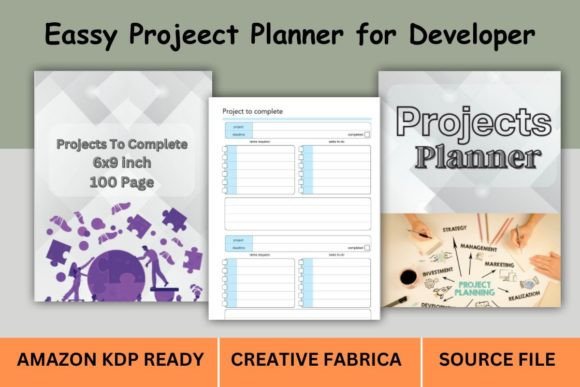
Blue Color Projects Planner KDP Cover: A Practical Asset for Seamless Book Production
Publishing a planner on Amazon KDP involves more than a great interior layout. The cover is the first point of contact with a potential buyer, and a professionally prepared cover file can mean the difference between a smooth launch and hours of troubleshooting. The Blue Color Projects Planner KDP Cover is designed to remove friction from that part of the process. When bundled with an additional one hundred ready-to-use files, it becomes a foundation for a repeatable, low-stress publishing workflow. This article explores how you can take this specific asset and integrate it into your own production routine—whether you sell on Amazon, Etsy, or any other e-shop—and what practical considerations come with digital downloads, print specifications, and long-term asset management.
Where a Prepared KDP Cover Fits in a Planner Publishing Workflow
For self-publishers in the low-content niche, the journey from idea to published product often gets bogged down in file preparation. You may have designed an ideal interior layout, selected the right trim size, and formatted a clean PDF. That last piece—a print-ready cover—requires technical precision. A Blue Color Projects Planner KDP Cover that arrives in CMYK, at 300 DPI, with a high-resolution source file included removes the guesswork. It steps in right at the stage where many creators stall: converting a visual design into a KDP-compliant file that passes Amazon’s automated checks.
You do not need to start from scratch or reverse-engineer margins and bleeds. The asset covers a specific trim size and page count (as noted on its mockup), so the first practical step is to align your planner interior with those dimensions. This backward alignment is a simple way to avoid reformatting headaches later. Once the interior matches, the cover file is opened, metadata placed if needed, and the full project can be uploaded.
What the Blue Color Projects Planner KDP Cover Package Actually Contains
It is easy to think of a cover as a single image. But a publisher’s efficiency improves when they receive multiple formats that serve different stages of the workflow. The included bundle often contains:
- A PDF and EPUB version for direct Kindle uploads or digital look-inside features.
- A high-quality PDF or AI source file that can be sent straight to print without conversion.
- CMYK color format files, which prevent color shifts between screen and print.
- EPS or AI vector versions for adaptation in illustration software.
- Source files that let you modify elements later without quality loss.
The presence of editable source files in particular changes how you can use a single purchase. You are not locked into a static design. If you intend to create a series—perhaps a student edition, a teacher edition, or a version with a different subtitle—the vector source allows small text changes while keeping the visual identity consistent. This turns a one-off cover into a reusable brand asset.
Integrating Ready-To-Use Files Into Your Daily Production Process
Working with ready-made files can feel like plugging a module into a larger system. Here is a workflow example that illustrates integration with common tools:
You download the package to your computer (the files arrive zipped, so extraction is step one). The folder typically includes a cover file clearly labeled with dimensions. You cross-check those against your planner interior, which might be designed in Canva, Adobe InDesign, or PowerPoint. If the interior’s trim size matches, you proceed. If not, you adjust the interior—this is usually faster than adjusting a pre-made cover that already meets KDP specifications for bleed and spine width.
Next, you open the cover PDF or AI file in your editing software. Even if you do not need to modify the design itself, you might add a barcode area or prepare it for upload. Amazon’s Cover Creator tool is not necessary; you can directly upload the print-ready PDF during the title setup process. The provided CMYK file should pass automated checks without errors. This predictability lets you move from asset download to upload preview in under ten minutes, making it practical for a publisher managing multiple titles.
Pairing With Other Tools and Platforms
The files are not tied exclusively to KDP. You can use them on Etsy as a physical product listing cover when combined with a printed planner, or as part of a print-on-demand integration through platforms like IngramSpark. The source file compatibility with Adobe Illustrator means you can further tweak graphics for other uses—for example, a matching social media banner or a 3D product mockup. Because the color profile is CMYK, you avoid the common mistake of uploading RGB images that print with off-tones.
Practical Implementation Tips for First-Time Users
When you receive a digital download bundle, a few small actions prevent larger problems later:
- Check the mockup notes first. Trim size, page count, and dimensions are often displayed on a preview image. Write these numbers down before starting any interior work. That way you build the planner to match the cover, not the other way around.
- Inspect the PDF in Adobe Acrobat or a similar reader. Look for proper bleeds—usually 0.125 inches beyond the trim edge. KDP guidelines vary by page count, so verify that the provided bleed matches the requirements for your book’s exact page count, especially if you are altering the interior length.
- Keep the zipped folder as a master copy. After extracting, duplicate the working folder. If you accidentally flatten a layer or delete a text object, you can revert to the original source file instantly.
- Use a computer for setup. Some tablets struggle with unzipping layered AI files or handling font embedding. A laptop or desktop gives you full control over the files and ensures the 300 DPI resolution remains intact during export.
For those who plan to release multiple planner variants (undated, academic year, quarterly), the ability to edit the source files directly reduces repetitive design work. You can create a master template from one Blue Color Projects Planner KDP Cover and then produce five variations by adjusting text layers alone. This approach respects both your time and your design budget.
Quality Control, Color Consistency, and Print Specifications
Print quality problems often surface only after a proof copy arrives—too dark, blurry, or with text cut off. Avoiding those issues begins with the file specifications you start with. This package’s focus on CMYK, 300 DPI, and high-resolution source files minimizes risk. But you still need to perform a quick pre-upload check.
Open the cover in a professional viewer that can display CMYK separations. Confirm that blacks are using rich black if appropriate, and that any white text is not set to overprint. If you have modified the file, ensure that any images you added are also 300 DPI and CMYK. A single low-resolution logo can trigger a quality warning. The vector format (EPS or AI) is inherently resolution-independent for shapes and text, but any placed raster images must be prepared at the correct resolution.
When you submit to KDP, the platform runs a print preview. Use the “Launch Previewer” feature before hitting publish. Flipping through a digital mockup might reveal alignment issues or margin problems that originate from mismatched trim sizes. Correcting them at this stage is far cheaper than ordering multiple proof copies.
Organizing Your Digital Assets for Long-Term Repeatable Use
After you publish the first planner using this cover, the files often get buried in a downloads folder. A small organizational habit will pay off when you want to create a second edition or a spin-off product. Create a clear folder structure:
- 00_Master_Assets: Original package as downloaded, untouched.
- 01_Working_Files: Copies you edit, with version numbers in filenames.
- 02_Exports: Final print-ready PDFs labeled by date and edition.
- 03_Published_Versions: Screenshots of the live listing, ASINs, and notes on the exact file used.
This structure works for any digital download—from planner covers to interior templates to the one hundred bonus files that may include supplementary graphics, icons, or marketing materials. When you later need to update the cover for a trend (such as changing “2025” to “2026”), you can locate the editable source file immediately and make the revision without recreating the entire design from memory.
Moving From Asset to Active Income Stream
The leap from owning a Blue Color Projects Planner KDP Cover to earning consistent income depends on completing the surrounding tasks with equal care. Your product listing copy, keyword research, category selection, and interior usability all contribute to conversion. But a strong cover is the click-through driver. With the technical side of cover creation handled, you can redirect time toward market research, A/B testing book descriptions, or building a brand that spans multiple planner types.
Using the included one hundred ready files—such as EPUB versions or supplementary PDFs—you can also bundle digital versions or offer a free sampler to build an email list. The versatility of having both print and digital formats in one package means the same asset serves multiple customer touchpoints without additional design investment.
Addressing Common Digital Download Concerns
Because this is a printable download without any physical shipment, your workflow must account for local file handling. Customers occasionally hesitate when they realize they need a computer to unzip files. Clarify this upfront in your product documentation or listing to reduce support messages. Similarly, if you are reselling planners or using this cover for a client project, communicate that the files are digital goods—no physical item will be shipped. This sets correct expectations and prevents refund requests due to misunderstanding.
For collaborative projects with illustrators or formatting specialists, share the source file directly via cloud storage. The vector nature allows team members to adjust colors or swap brand elements without degrading the file. This makes the Blue Color Projects Planner KDP Cover an adaptable piece of a larger collaborative publishing effort rather than a closed, uneditable graphic.
Conclusion: Turning a Single Purchase Into a Scalable Process
A well-prepared cover file package does more than save ten minutes of design time. It establishes a reliable checkpoint in your publishing routine. When you know exactly how the cover will interact with KDP’s print requirements, you stop dreading the upload stage and start focusing on what matters—creating planners people want to use. By treating the Blue Color Projects Planner KDP Cover and its companion ready files as the core of a reproducible workflow, you build a publishing system that stays efficient even as your catalog grows. The supplied CMYK, 300 DPI specifications, editable source files, and multi-format outputs align with real-world production needs, while the emphasis on digital download management keeps your process grounded in practical, repeatable steps. Whether you are publishing your first planner or your fiftieth, having a consistent, quality-controlled starting point like this keeps your creative energy where it belongs: on delivering value to your audience.