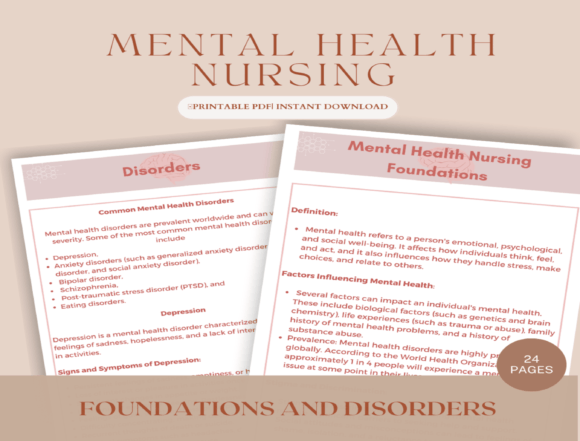
Mental Health Nursing Notes: A Practical Framework for Learning, Reference, and Real-World Integration
When you’re building a career in nursing, psychology, or any field that touches mental health, you need resources that do more than summarize. You need tools that fit into your actual workflow—whether that’s a pre-clinical preparation routine, a last‑minute review before an exam, or a thoughtful reflection after a difficult conversation with a patient. Mental Health Nursing Notes is a 24‑page printable PDF designed precisely for that kind of seamless integration. It’s a compact yet comprehensive study companion that covers foundational nursing concepts, major disorders, and key pharmacology, all organized for quick navigation and long‑term use.
Instead of juggling multiple textbooks or scrolling through endless online summaries, you can keep a single, curated resource within arm’s reach. The printable nature of the guide means you decide how it enters your life: loose sheets tucked into a clinical binder, a bound booklet for desk use, or digital annotations on a tablet. This flexibility transforms it from a static document into a dynamic part of your learning and practice process.
What’s Inside Mental Health Nursing Notes
Before diving into how it works within your routine, it helps to understand its structure. The guide opens with Mental Health Nursing Foundations, unpacking definitions, factors that influence mental health, the impact of stigma and discrimination, and the critical components of the therapeutic relationship. It also touches on cultural considerations, coping and defense mechanisms, neurotransmitter actions, and treatment options. This isn’t just a glossary; it’s a coherent framework that connects theory to practice.
From there, the notes move into detailed disorder‑specific sections. Each one follows a consistent pattern, covering signs and symptoms, nursing interventions, treatment approaches, and relevant medications. The conditions addressed include:
- Depression
- Anxiety Disorders
- Bipolar Disorder
- Schizophrenia
- Post‑Traumatic Stress Disorder (PTSD)
- Eating Disorders (Anorexia, Bulimia, Binge Eating)
The pharmacology section is equally targeted. It breaks down drug classes that every mental health nurse must know: Lithium, SSRIs, SNRIs/DNRIs, TCAs, MAOIs, benzodiazepines, and antipsychotics. Instead of getting lost in exhaustive detail, it highlights what matters most for safe, effective care. This design reflects a clear understanding of how real professionals use reference materials—not to learn everything from scratch, but to recall, verify, and deepen what they already know.
Where Mental Health Nursing Notes Fits into a Broader Process
Learning doesn’t happen in a vacuum. It’s surrounded by schedules, clinical rotations, self‑care routines, and professional development goals. Mental Health Nursing Notes earns its keep by being adaptable to multiple touchpoints in that process.
Consider the typical nursing student’s week. You attend lectures, read dense chapters, complete care plans, and prepare for simulation labs or clinical placements. This PDF can sit at the intersection of these activities. Before a mental health clinical shift, a quick scan of the disorders section refreshes your memory on what to expect. After a challenging patient encounter, reviewing the therapeutic relationship and coping mechanism notes helps you process the experience and strengthen your approach for next time. It’s not about memorizing; it’s about creating a feedback loop between theory and real‑world practice.
For professionals who are already working, the notes serve a different but equally valuable purpose. A counselor, wellness coach, or educator might integrate them into client preparation materials or personal continuing education. Because the printout is self‑contained, you can mark up the pages with observations from your own cases, gradually turning the generic guide into a personalized knowledge base that mirrors your specific work context.
Integrating the Printable Format into Your Workflow
The fact that this resource is a printable PDF isn’t a small detail—it’s the core of its compatibility with different working styles. Here’s how that format can be leveraged practically:
Start by deciding on a binding and storage strategy. Hole‑punch the sheets and insert them into a three‑ring binder alongside your class syllabi, clinical paperwork, or other quick‑reference guides. Alternatively, staple them into a booklet that fits in a scrub pocket or a backpack sleeve. Some people prefer to keep the PDF on a device for on‑the‑go searching and print only the pages they need in a given week. For example, you might print the anxiety and depression sections during your behavioral health module, then tuck away the pharmacology pages for later when you’re preparing for the NCLEX or a certification exam.
This phased printing approach prevents overwhelm and encourages incremental integration. Rather than treating all 24 pages as a monolith, you align them with your immediate learning or work demands. It’s a method that respects cognitive load and turns a static document into a modular toolkit.
Another workflow advantage is the ability to annotate freely. Highlighters, sticky notes, and margin comments turn the PDF into an active learning canvas. When you come across a neurotransmitter action that keeps appearing in your patients’ medication lists, a penned connection between the pharmacology table and your practical observations solidifies the knowledge faster than passive reading ever could.
Using the Notes Alongside Other Tools and Resources
No single resource should stand alone. Mental Health Nursing Notes works best when paired with primary textbooks, clinical guidelines, and reflective journals. Think of it as the bridge between detailed theory and condensed memorization. For instance, if your textbook spends 40 pages on schizophrenia, these notes give you the streamlined cues to revisit before exams or during a medication pass. You might use them to create flashcards, populate a study group discussion agenda, or check your understanding after watching a case study video.
For entrepreneurs and creators in the wellness space, the guide also functions as a credibility‑booster. When designing a workshop on stress management, the notes on anxiety, coping mechanisms, and treatment options provide a solid, accurate foundation from which to build audience‑friendly content. They ensure you’re not over‑simplifying or misrepresenting conditions, which is a quiet but important aspect of professional integrity.
Long‑Term Use and Knowledge Maintenance
The value of a well‑organized reference doesn’t end when a course does. Mental health concepts can fade if they aren’t regularly revisited. Keeping the printed notes in a personal library or on a reference shelf allows for effortless periodic review. A quarterly skim of the foundation section can reinforce therapeutic communication skills that apply in any care setting, not just mental health. Revisiting the pharmacology pages before annual competencies keeps drug knowledge fresh without the need for a full‑scale study session.
Because the pages are dated only by your printing, you can also update them with new insights over time. Add sticky notes with recent research findings or updated guidelines to keep the information current. This living‑document approach aligns with how real professionals maintain competence—through layered, continuous learning rather than a one‑time deep dive.
Practical Implementation Tips for Different Audiences
Whether you’re a future nurse in the thick of coursework, an educator designing curriculum, or a productivity‑minded individual wanting to better understand your own mental health, the path to integrating Mental Health Nursing Notes follows similar principles:
- Map it to your schedule: Identify specific moments when a quick reference would reduce stress or improve accuracy. Pre‑clinical checks, study group prep, and post‑clinical reflections are natural points of insertion.
- Customize the output: Print on heavier paper if you’ll handle the sheets frequently, or use color‑coded page markers for rapid section access. Little details like this drastically improve usability over time.
- Combine with active recall: After reading a disorder section, close the notes and try to list the symptoms and first‑line medications from memory. Then check against the printout. This transforms the PDF from a passive aid into an active study tool.
- Keep it humble: The notes are a supplement, not a replacement for deeper study. Use them to reinforce and quickly cross‑check, but always return to primary sources for full understanding.
Why a Compact, Paper‑Friendly Resource Still Wins
Digital‑first workflows are common, but there’s a reason printable study guides remain popular. They eliminate screen fatigue, allow tactile engagement, and can be used in environments where devices aren’t practical or permitted. A 24‑page set of notes fits perfectly into the gaps of a busy day: five minutes before rounds, ten minutes on a commute, or a quick consultation during a quiet moment at a community health fair. The consistency of having the same trusted framework at your fingertips builds familiarity, which in turn builds confidence.
Mental Health Nursing Notes also respects the need for a compassionate, non‑judgmental tone. The sections are written to reduce stigma and encourage understanding, making them safe to share with peers or even with curious family members who want to educate themselves about mental health conditions. This dual role—study aid and empathy‑building document—expands its usefulness far beyond a single educational context.
Bringing a resource like this into your workflow isn’t about adding more stuff to your to‑do list. It’s about replacing scattered, low‑quality information grabs with a single, coherent touchpoint that saves time and deepens comprehension. When you treat the notes as a core component of your study ecosystem—alongside lectures, clinical hours, and reflective practice—you create a streamlined, repeatable process that supports both exam success and real‑world competence. And because the file is a digital download, you can reprint sections as needed or share the document across devices while always having a crisp, clean copy ready when you need to sit down and focus.