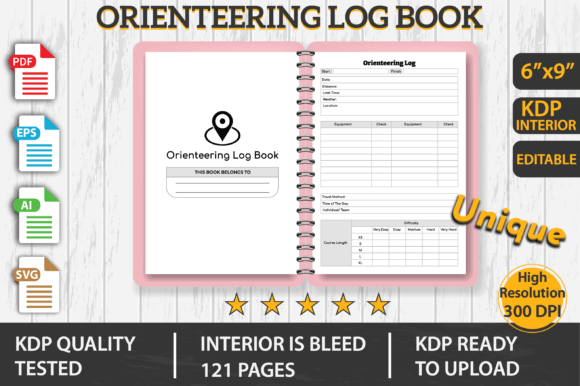
Track Every Trail with an Orienteering Log Book
If you have ever set out on a cross-country navigation course, compass in hand and map folded just right, you know how quickly the details blur together after a few outings. An Orienteering Log Book KDP Interior offers a structured way to capture those moments, turning scattered memories into a personal archive of progress, discovery, and skill development. Whether you are a weekend enthusiast, a coach guiding newcomers, or someone building a niche product for the outdoor community, this ready-to-publish interior file removes the heavy lifting from creating a polished, professional log book.
At its core, this digital product is a fully designed interior template formatted for Kindle Direct Publishing. It is not a physical book sitting on a shelf. Instead, it is a downloadable package you can upload directly to Amazon's self-publishing platform or modify to suit your exact vision. The package includes a high-quality print-ready PDF, along with editable source files in formats like AI, EPS, and SVG. That means you can tweak colors, rearrange sections, or add your own branding without starting from scratch.
What Makes This Log Book Interior Different
Many generic templates feel exactly that—generic. The Orienteering Log Book KDP Interior stands apart because it was built with a specific activity in mind. The layout anticipates what orienteers actually need to record: course name, date, terrain type, compass bearings taken, checkpoints visited, time elapsed, and personal reflections. The design cues feel outdoorsy and clean without being cartoonish, striking a balance that appeals to adults who take their navigation seriously but also appreciate an uncluttered page.
The trim size of 6×9 inches hits a comfortable sweet spot. It fits easily into a small daypack or glove compartment, yet provides enough writing space for detailed entries. With 121 pages, the journal offers ample room to log dozens of outings before needing a replacement. The bleeds are included, which is a technical detail that matters immensely during the KDP upload process. When a file includes proper bleed, your printed pages will have color or design elements extending right to the edge of the paper without awkward white margins. The upload-ready PDF has been tested on Amazon's platform and passes error-free, saving you from the frustration of rejection emails and re-export marathons.
Why Someone Might Want This Interior
Different people come to a product like this for different reasons. Understanding where you fit can help you decide whether this template meets your needs.
For the orienteering participant or club organizer: Keeping a consistent log transforms the sport from a series of standalone events into a long-term learning journey. You start to notice patterns. Which types of terrain slow you down? At what point in a course do you typically lose focus? A dedicated log book encourages honest reflection, and the intro page—complete with a “belongs to” section—makes it feel like a personal tool rather than a stack of loose notes.
For the coach, educator, or youth leader: Introducing orienteering to beginners involves teaching map reading, compass work, and route planning. A structured log book gives students a uniform way to record their experiences. You can review their entries to identify common struggles and tailor your next session accordingly. Having an editable source file means you can adapt the interior to include your organization's logo, safety reminders, or specific skill checklists.
For the KDP seller, blogger, or creative entrepreneur: The outdoor recreation niche on Amazon remains steadily popular, but competition rewards those who offer something thoughtfully designed. Rather than commissioning a custom interior from a freelancer—which can cost significantly more and take weeks—you receive a complete package you can brand and publish quickly. Because you receive the original AI and EPS files, you can translate the content into another language, adjust the interior to focus on a related activity like geocaching or trail running, or create multiple variations for different audience segments.
Practical Ways to Use and Customize the Interior
The editable nature of this product opens up possibilities that a fixed paperback simply cannot offer. Here are a few realistic scenarios that show how adaptable the interior can be.
Scenario 1: You run a small outdoor club in the Pacific Northwest and want to provide members with a branded log book for the upcoming season. You open the AI file, insert your club's emblem on the cover page, adjust the “Intro Page” text to include a short welcome message, and export a fresh PDF. Within an afternoon, you have a personalized product ready to gift or sell at events.
Scenario 2: You are a KDP publisher who focuses on niche hobby journals. You appreciate that the interior already includes 121 pages and proper bleed, because formatting those elements manually can be tedious and error-prone. You change the color accents, update a few headings to broaden the appeal (perhaps adding a section for GPS coordinates alongside traditional compass bearings), and list the book under both orienteering and general outdoor navigation categories.
Scenario 3: A physical education teacher wants to introduce a six-week orienteering unit. The school cannot order custom materials, but the teacher can download this interior, adjust a few pages to align with the curriculum, and print spiral-bound copies for each student using the school's resources. The “belongs to” page gives each student a sense of ownership over their learning journey.
Understanding the Technical Specifications
Let us translate the feature list into plain language, because knowing what you are getting helps you avoid surprises later.
- Dimensions (6×9 inches / 15.24 x 22.86 cm): This is one of the most common trim sizes on Amazon KDP. It keeps printing costs predictable and looks proportional on a store page thumbnail. The aspect ratio provides a comfortable writing area without making the book feel bulky.
- 121 pages: This count gives you enough depth to feel substantial. Readers perceive value in a journal that lasts more than a few weeks. The page count also influences the spine width, which affects how the cover design wraps.
- With bleed: Bleed means design elements extend beyond the trim edge, typically by 0.125 inches. When the printer cuts the pages, any slight misalignment will not leave a white strip. This detail separates amateur-looking interiors from professional ones.
- Editable source files (PDF, EPS, AI, SVG): Each format serves a purpose. PDF is the upload-ready file. AI and EPS are vector formats you can open in Adobe Illustrator or similar software. SVG is widely compatible with free design tools. Having all four means you are not locked into a single editing ecosystem.
- Tested on KDP with no errors: Amazon's platform checks for issues like insufficient margins, low image resolution, or text that sits too close to the trim line. An interior that passes these checks on the first attempt shortens the time between idea and published product.
- Intro page with “belongs to” field: A small addition that boosts the emotional connection a user feels. It suggests the log book is a personal possession rather than a disposable notebook.
Who Should Consider This Interior
The audience for a well-crafted orienteering log book spans several groups, though not everyone will need the same features. Beginners just learning to read a topographic map benefit from a journal that prompts them to note what worked and what did not. Casual weekend navigators who only participate in a handful of events each year still appreciate having a dedicated place to track those outings, especially when looking back across seasons. Competitive orienteers often keep detailed training logs, and while some prefer digital spreadsheets, many still value the tactile act of writing by hand immediately after crossing the finish line.
Beyond participants, small business owners in the outdoor industry can use this interior to launch a product line without hiring a designer. Bloggers who write about hiking, camping, or navigation skills can create a companion journal that deepens audience engagement. Freelance graphic designers can study the file structure to understand how a print-ready KDP interior is constructed, using it as a learning resource for their own client projects.
Important Things to Keep in Mind
Before purchasing or using an Orienteering Log Book KDP Interior, a few practical considerations will help you set realistic expectations.
First, this is a digital template, not a finished book. You will need to upload it to a platform like Amazon KDP and pair it with a cover design before it becomes a purchasable product. If you plan to sell the resulting journal, you must create or source a cover separately. The interior files provide the pages readers will write on, but the cover is what attracts their attention first.
Second, while editing the source files is straightforward for someone comfortable with vector design software, complete beginners may face a learning curve. The good news is that the PDF version is ready to use as-is, so you can publish immediately without touching a single design element if you prefer.
Third, consider how specialized you want the log book to be. The existing layout focuses on classic foot orienteering. If your audience leans heavily toward mountain bike orienteering, ski orienteering, or trail running with navigation, you might want to adjust some terminology and field labels using the provided editable files. The flexibility is there, but it requires a small time investment on your part.
Finally, think about the printing experience. The 121-page count and 6×9 trim size produce a lightweight, portable journal. That portability is a feature, not a drawback. A thick, heavy log book might stay at home, while a slim one actually gets taken into the field. The paper quality will depend on Amazon's printing process, which for KDP typically uses a white, medium-weight stock that handles most pens and pencils without significant bleed-through.
The Value of a Purpose-Built Tool
Generic notebooks work fine for jotting down quick notes, but they do not guide the writer toward meaningful reflection. An Orienteering Log Book KDP Interior shapes the logging experience by providing intentional fields and a consistent structure. After a dozen entries, you start to see your own growth mapped out across the pages—faster split times, fewer navigational errors, and a growing confidence in terrain that once felt intimidating.
For content creators and entrepreneurs, the value lies in speed and professionalism. You skip the weeks of back-and-forth with a designer and receive files that meet KDP's technical requirements out of the box. The ability to rebrand, translate, or niche down the interior means one purchase can support multiple products over time.
Whether you are logging your own adventures or building a product for a community of outdoor enthusiasts, a dedicated log book interior turns a good idea into something tangible and useful. The combination of thoughtful design, technical readiness, and editing flexibility makes this particular template a practical starting point for a wide range of projects.