Sudoku Puzzles for Young Children: A Smart Introduction
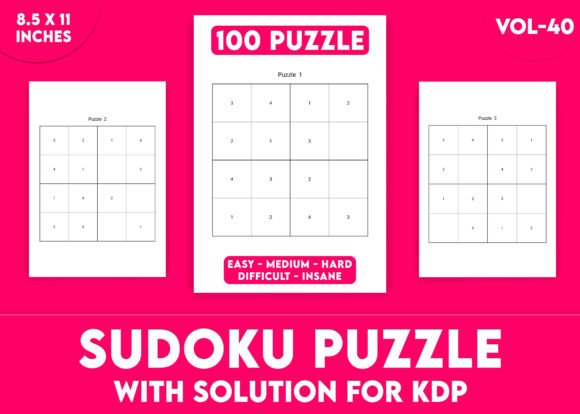
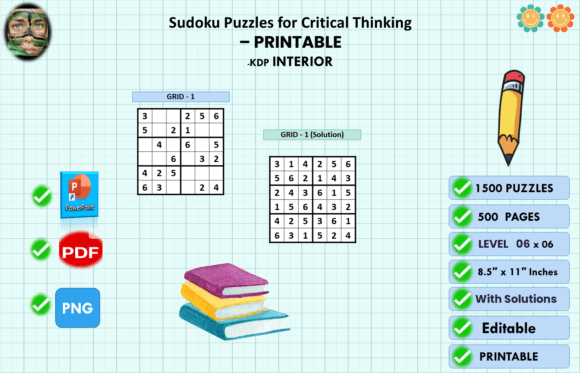
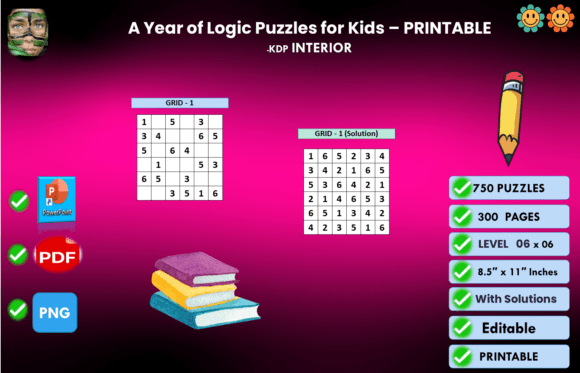
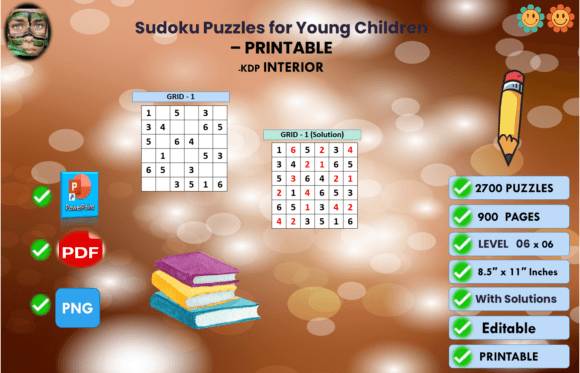
Many adults remember their first encounter with a number puzzle—maybe a crossword or a word search. For a new generation, the 4x4 and 6x6 grids inside Sudoku Puzzles for Young Children are quickly becoming the gateway to logical thinking. This isn’t just another activity book. The Beautiful Sudoku Book For Kids And Beginners strips away the intimidation of a 9x9 classic and replaces it with playful, manageable grids that fit naturally into a child’s hand. The book’s 8.5″ x 11″ dimensions and large print mean squinting is never part of the experience, and every puzzle comes with a clear solution tucked in the back—a small detail that makes a big difference when you’re guiding an eager learner.
What makes a puzzle collection like this genuinely useful for a parent, a primary school teacher, or even an adult dipping a toe into logical games isn’t just the content. It’s the thoughtful physical design. No bleed pages let you use a pencil, an eraser, or even a light marker without ghosting through to the next challenge. The book presents tons of challenges from easy and gradually nudges the solver forward. This isn’t about racing to the finish; it’s about building a comfort zone around deduction, pattern recognition, and trial-and-error reasoning.
What Sets a Beginner-Friendly Sudoku Book Apart
Walk into any bookshop and you’ll see shelves of puzzle books, but very few are actually built for small hands and fresh minds. The Sudoku Puzzles for Young Children volume addresses a few core design weaknesses common in mass-market puzzle books. First, the grid size. By starting with 4x4 puzzles that use numbers 1 through 4, the book eliminates the cognitive overload that a 9x9 grid can cause. Kids (and hesitant adult beginners) can focus on the mechanics—checking rows, columns, and small blocks for missing digits—without drowning in possibilities.
The large print is another subtle but powerful feature. For a six-year-old whose fine motor skills and visual scanning abilities are still maturing, cramped, tiny cells are a genuine barrier. The generous spacing in this 8.5″ x 11″ format turns each puzzle into a clear, focused task. And because the book uses a no-bleed paper stock, a child can press down firmly with a pencil without ruining the next page. Combine that with the built-in solution section, and you have a resource that supports independent checking. A child can solve a puzzle, flip to the back, and verify the answer immediately—no adult intervention required. That self-service moment builds far more confidence than always asking, “Did I get it right?”
Why Sudoku Matters for Early Cognitive Development
It’s easy to label Sudoku as a pure logic game, but the ripple effects go much deeper. When a young learner works through a puzzle from Sudoku Puzzles for Young Children, they’re not just filling in numbers. They’re learning to hold two or three constraints in mind at once. A digit can’t repeat in a row, can’t repeat in a column, and can’t repeat in the thick-bordered block. That kind of layered reasoning is a quiet workout for executive function. Over time, you’ll notice a shift in how a child approaches other tasks—whether it’s sorting toys by multiple attributes or following a recipe step by step.
For educators and homeschooling parents, this book becomes a low-prep tool for teaching logical scaffolding. You can sit beside a child and think aloud: “I see a 2 here and a 3 here. The last empty square in this row must be a 4 because that’s the only number we haven’t used.” That verbal modeling turns an abstract process into a shared language. The book’s gentle difficulty curve—each section adding just one small twist—reinforces the habit of persistence without triggering frustration. Many early-grade math curricula now incorporate pattern recognition and logical reasoning as foundational skills, and a well-designed Sudoku book fits neatly into that framework without feeling like a workbook drill.
Practical Ways to Use the Book in Daily Life
Beyond the classroom, Sudoku Puzzles for Young Children carves out a valuable space in family routines. Consider the restaurant wait, the long car ride, or that restless hour before dinner. A tablet loaded with games often hooks attention, but it rarely builds the same kind of quiet focus. Placing this puzzle book and a sharp pencil on the kitchen table creates a calm, screen-free zone. Because the puzzles start deceptively easy, even a fidgety five-year-old can experience a quick win. That early success often turns into a 15-minute deep dive, which is gold for a parent needing to cook or make a phone call.
For creative professionals or entrepreneurs who have young children at home, this book can be part of a “parallel work” setup. While you tackle a design brief or balance a spreadsheet, your child sits nearby with their own “thinking work.” The large print and clear layout let them feel like they’re doing serious, important tasks—mirroring your own focus. That modeling of deep work, done side by side, is a subtle but lasting lesson. And because the book includes solutions, you’re not pulled away constantly to check answers. The child learns to self-assess, a skill that directly transfers to later academic independence.
How to Choose the Right Entry-Level Sudoku Book
If you’re evaluating a puzzle book for a young beginner or for yourself as a newcomer, a few practical criteria can make the difference between a resource that gathers dust and one that gets dog-eared. Start with the physical attributes. Is the book truly large format? An 8.5″ x 11″ page gives ample room for both the grid and any scratch notes. Next, check the binding. A book that lies flat or folds back comfortably is far easier for a child to use than a tight-spined paperback that snaps shut. The Beautiful Sudoku Book For Kids And Beginners understands this balance, offering a generous footprint without being unwieldy.
Then examine the puzzle progression. A book that jumps from 4x4 straight to a full 9x9 with no midpoint risks losing the learner’s trust. Look for intermediate steps—6x6 puzzles, for instance—that introduce a slightly wider number range while still feeling manageable. The inclusion of solutions is non-negotiable. Without a solution key, a beginner has no way to self-correct, and errors can become deeply embedded. Finally, consider the visual design. Cluttered pages, loud borders, or distracting illustrations can pull attention away from the logic task. Clean, high-contrast digits and simple grid lines keep the cognitive load where it belongs: on the reasoning, not on decoding the layout.
Using Puzzle Difficulty to Build a Routine and a Growth Mindset
One of the most practical applications of Sudoku Puzzles for Young Children is in shaping a child’s relationship with effort and mistakes. Because the early puzzles are so accessible, children experience a high success rate right away. That positive reinforcement builds a reservoir of goodwill, so when they encounter a slightly harder grid—say, a 6x6 that has fewer given numbers—they’re more willing to lean into the challenge. You can externalize this process by having them date each completed puzzle. Flipping back and seeing a timeline of wins creates a visual progress journal that’s entirely their own.
If a puzzle stumps them, the built-in solutions prevent a dead end. But instead of just looking up the answer, encourage a “spot the difference” approach. Have them place their completed grid next to the solution and find the first diverging digit. That’s the cell where the logic chain broke. This transforms a mistake into a diagnostic tool, not a failure. Over time, children start to develop their own internal checking habits—scanning a row one last time before declaring a puzzle finished—a habit that pays dividends in standardized testing, coding, and any field requiring systematic verification.
Beyond Childhood: Sudoku as a Shared Language
While the book is clearly designed for young solvers, its value doesn’t evaporate at a certain age. Many adults who never tried Sudoku feel a similar intimidation toward the 9x9 grid as a child does. Picking up a copy of Sudoku Puzzles for Young Children can serve as a low-stakes on-ramp. The large print and straightforward designs strip away the pressure, letting an adult’s logical brain wake up gently. Some families use the book as a multi-generational bridge: an older sibling teaches a younger one, a grandparent works through a puzzle alongside a grandchild, or a caregiver uses it to connect with a child during a hospital stay or a stressful transition.
For entrepreneurs and freelancers who coach or mentor, this book can be a surprisingly effective tool in workshops that touch on process thinking. Pulling out a simple 4x4 puzzle during a session on problem-solving or constraint management makes the abstract suddenly tangible. Participants see immediately how one small decision (“I’ll put a 3 here”) cascades into limitations elsewhere. The book’s physical presence—no screens, no apps—reinforces a deliberate, thoughtful pace that’s rare in digital brainstorming sessions.
Making the Most of the No-Bleed Design and Large Print
A feature like “no bleed” might seem minor until you’ve watched a child press down with a freshly sharpened Ticonderoga and create a graphite ghost on the reverse side of a puzzle. The paper quality in Sudoku Puzzles for Young Children means each puzzle sits on its own island. That’s critical when you want to photocopy a page for a classroom or a playgroup. The 8.5″ x 11″ dimensions match standard copier paper exactly, so you can reproduce a puzzle cleanly without awkward cropping or reduced sizing. Teachers often laminate a few pages to create reusable logic stations with dry-erase markers, and the no-bleed originals ensure that the source book stays intact and useable for years.
The large print also serves an accessibility function beyond childhood. Elderly family members, individuals with low vision, or learners with certain processing differences find that the spacious layout reduces visual fatigue and helps them sustain attention longer. In these contexts, the book becomes more than a children’s activity—it’s a universally designed puzzle collection that meets a wide range of needs without calling attention to them.
Integrating the Book into a Broader Learning Ecosystem
No single puzzle book will teach a child logic, but Sudoku Puzzles for Young Children pairs exceptionally well with other hands-on materials. Place it alongside pattern blocks, tangrams, and simple coding games like robot turtles. The skills cross-pollinate. A child who has physically moved pattern blocks to complete a symmetrical design will have an easier time understanding the spatial constraints of a Sudoku row. Similarly, a child comfortable with the “if this, then that” reasoning of the puzzles will find early programming concepts more intuitive.
For bloggers, content creators, or publishers looking to recommend resources to their audience, this book offers a concrete, tangible product that aligns with screen-free learning movements and mindful parenting trends. It’s easy to photograph, lay flat in a flat lay, or feature in a roundup of “quiet time essentials.” The clean, uncluttered cover and interior pages translate well in digital imagery, and the practical features—solutions, large print, dimensions—give reviewers honest, specific talking points that go beyond generic praise.
A Thoughtful Starting Point, Not a Flashy Gimmick
What ultimately makes a resource like Sudoku Puzzles for Young Children stick around in a home or classroom isn’t gamification badges or digital bells. It’s the quiet reliability of a well-made book. A five-year-old can curl up on a couch with it. A busy teacher can grab it during indoor recess. A parent can toss it into a backpack for a flight. Every design decision—from the no-bleed pages to the included solutions—serves the core mission: remove friction so the thinking can take center stage. When you find a puzzle collection that respects both the learner’s intelligence and their physical needs, you hold onto it. And often, you pass it down.
If you’re building a library of thinking tools for a young child, or if you simply want to understand what makes Sudoku so addictive without the immediate overwhelm of a 9x9 grid, this book earns its spot. It’s a quiet, solid, and genuinely helpful addition—and those are qualities that never go out of style.