Organized Teaching with a Weekly Lesson Plan Template
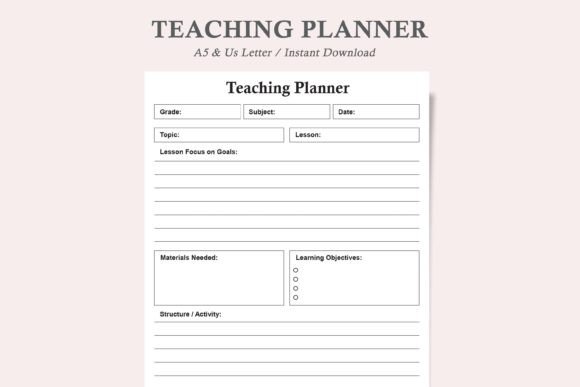
Every instructor knows the scramble of an unplanned week. You find yourself pulling together last‑minute activities, forgetting to prep specific materials, or losing track of a student’s progress across subjects. A dependable lesson plan template acts as a quiet anchor. It turns intention into action by giving you a ready‑to‑use space where objectives, daily tasks, and supplies live together. The printable lesson planner we explore here embraces that idea with a clean weekly layout, offered in both US Letter and A5 sizes, so you can print exactly what you need without cluttering your desk or your mind.
Why a Clear Lesson Planner Reduces the Hidden Mental Load
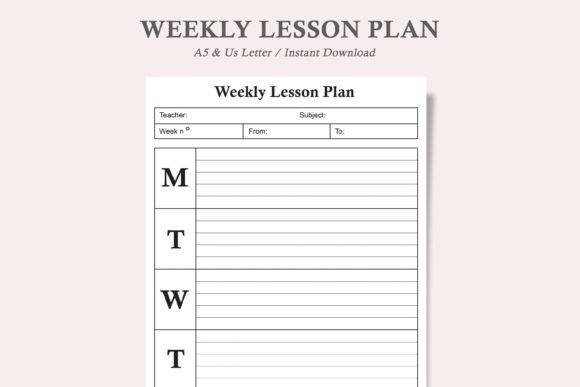
Teaching demands dozens of micro‑decisions before the first activity even begins. Which standard will I cover? Do I have the right handouts? How do I weave in a review from last month? A thoughtfully designed weekly lesson plan template offloads that cognitive burden. Instead of holding everything in your head, you transfer it to a structured page that already sections out Monday through Friday, subjects, and a dedicated notes area. The minimalist, ink‑friendly design means you aren’t distracted by decorative borders or wasteful graphics—every line serves a purpose. When you glance at a completed page, you see your entire week’s rhythm at a glance, which reduces the Sunday evening anxiety that often accompanies preparation.
For educators who teach multiple grade levels or subjects, this weekly overview becomes even more essential. You can quickly spot that Tuesday has too much direct instruction and adjust Wednesday’s pace. The template keeps your curriculum cohesive without forcing you to rewrite the same routine over and over. Because you download a PDF and JPEG, you can keep a master copy on your device and reprint it for each new week, making it a reusable system rather than a disposable purchase.
How Different Teaching Roles Shape the Way You Use the Same Template
One of the quiet strengths of a well‑built lesson planner is that it doesn’t lock you into a single teaching style. The same weekly structure can flex to serve a third‑grade classroom, a high school chemistry lab, or even a home‑based music studio. The key is in how you fill the boxes, not the boxes themselves. Below are a few ways real users adapt the template to their unique contexts.
The Classroom Teacher’s Daily Command Center
A fifth‑grade teacher might print a new page every Friday afternoon. She blocks out her reading block from 9:00 to 10:15, writing the standard and a short activity description in the Monday cell. In the notes column, she jots “gather highlighters, print comprehension cards.” Across the week, she can see the arc of the unit—fiction analysis moves from character study to theme essays by Thursday. The consistent layout prevents her from over‑scheduling a single day, and if a fire drill disrupts Tuesday, she simply shifts the plan to Wednesday’s empty note area. Because the template comes in a US Letter size that matches standard binders and photocopying, she easily squirrels a few blanks into her planner sleeve for on‑the‑fly brainstorming.
A Homeschool Parent Planning Across Ages
Homeschool families often juggle a second‑grader, a seventh‑grader, and a preschooler. A printable lesson plan template that welcomes you to print additional pages becomes a lifesaver. One parent may fill a separate sheet for each child, color‑coding the border with a marker for quick identification. Others prefer an A5 size to create a compact weekly book that fits inside a tote bag for co‑op days. The notes section might transform into a record of enrichment activities—a library visit, a hands‑on science experiment, a nature walk journal entry. There’s no mandated “right” way, and that flexibility is what makes a printable planner feel so personal. Over the year, the collected sheets turn into a portfolio that demonstrates learning far better than a generic syllabus ever could.
Tutors and Coaches Tracking Student‑Specific Progress
For a one‑on‑one tutor, each week holds multiple short sessions with different learners. A blank lesson planner shifts from a broad subject grid to a client‑centric map. In the Monday block, the tutor writes “Alex – algebra: factoring practice; pre‑test anxiety strategies.” The notes area might contain quick observations: “struggles with negative signs; try visual anchor chart.” Because the design is intentionally bare, the tutor doesn’t waste time navigating a cluttered layout. The JPEG format also allows her to pull the sheet into a tablet annotation app and mark progress on‑screen during a session, blending the tactile appeal of handwriting with the convenience of digital storage.
Evaluating a Lesson Plan Template: What Matters Beyond the Headline
When you browse for a planner, it’s easy to be dazzled by fancy covers or trendy fonts. Yet the features that actually affect your daily work are often subtle. Here’s what to pay attention to, and how this specific template addresses those practical needs.
Ease of use. A template should require zero learning curve. You purchase, download the files, and print. That’s it. The included PDFs are sized for both US Letter and A5, so you don’t need to fiddle with scaling settings. If you prefer a smaller format for a planner insert, A5 is ready; if you want a full‑page workbook, Letter works.
Cost and reusability. A one‑time purchase that yields infinite prints is friendlier to a tight budget than a yearly bound planner. Ink‑friendly design also means you aren’t burning through expensive cartridges on heavy color fills. Many teachers and homeschoolers keep a master file and only print the next week as it arrives, avoiding waste.
Flexibility of format. Receiving both PDF and JPEG gives you options. Print a paper copy for your binder, or use the JPEG on a digital planner app like GoodNotes or Notability with a stylus. Some users even upload the PDF to a tabletop display and reference it throughout the day without using paper at all. This hybrid freedom is rare in a minimal template.
Presentation and organization. A weekly overview that segments days and includes a dedicated notes column ensures you don’t mix lesson details with random reminders. The simple lines guide your eye horizontally, so you quickly assess Monday’s load versus Friday’s. Over time, a consistent visual language helps you plan faster.
Printable vs. Digital: Choosing What Actually Sticks
There’s an ongoing debate about whether a lesson planner should live on a screen or on paper. Research suggests that writing by hand improves memory encoding, which is why many educators still prefer the physical act of planning. A printable template respects that preference while also providing a digital safety net—if you lose a Monday sheet, you can reprint it from the saved file. For those who love cloud sync, the JPEG can be dropped into a note‑taking app and carried everywhere. This duality makes the template a comfortable fit for both tech‑savvy and tech‑minimal users. It doesn’t force an either‑or choice; it meets you where you are.
A classroom teacher might print a fresh set each week and hole‑punch them into a planning binder that serves as a substitute teacher’s reference. An online course creator might instead mark up the JPEG on a tablet, adding links to slide decks and video resources before exporting a final plan to share with an assistant. The same core structure supports both workflows because it doesn’t assume a single tool.
Practical Ways to Stretch Your Weekly Planner Further
A printable template gains value the longer you use it. Here are a few ideas to transform a simple sheet into a long‑term system:
- Create a curriculum archive. Keep completed weeks in a binder dividers by month. Over summer break, you can review which units took longer than expected and spot gaps you want to fill next year.
- Laminate for reuse. If you teach the same content to multiple groups, laminate one weekly sheet and write on it with a wet‑erase marker. At the end of the week, wipe clean and start fresh.
- Color‑code by subject or child. Use a different pen color for each subject—blue for math, green for science—so that at a glance you can see the balance of your week. Homeschoolers often assign a color per child.
- Pair with a habit tracker. Use the notes area to log your own professional growth goals: “read chapter 4 of teaching book,” “attend Tuesday webinar.” The planner becomes a holistic work‑life map, not just a task list.
- Share digitally with a co‑teacher or partner. Scan or photograph your filled‑out page and send it via email. The JPEG format makes this especially quick.
These small adaptations turn a static template into a dynamic backbone for your teaching week. The goal isn’t perfection; it’s steady improvement that builds on a dependable structure.
Recognizing If This Planner Matches Your Season of Teaching
Not every tool fits every educator, and that’s a good thing. This particular lesson plan template works best for those who value simplicity, need to keep printing costs low, and prefer to customize how they fill a week. If you thrive on high‑gloss, elaborate layouts with stickers and washi tape, you may want a more decorative option. But if you find that clutter slows you down, the minimalist, ink‑friendly design will feel like breathing room. It’s also an excellent fit for anyone transitioning from sticky notes and scattered notepads to a cohesive system without a steep learning curve.
Beginners often appreciate that the template doesn’t overwhelm them with fields like “essential question,” “formative assessment,” and “differentiation” all separated. Instead, the open daily blocks give permission to write whatever matters most—whether that’s an inquiry prompt, a lab procedure, or a quick phonics drill. Experienced educators, on the other hand, can layer their own sophisticated frameworks onto the clean slate without fighting against pre‑printed headings that don’t align with their school’s jargon.
The addition of A5 sizing is a thoughtful touch for those who prefer compact planners or disc‑bound systems. Small‑business owners who coach or run micro‑schools can print A5 pages to slip into a leather folio for a polished client‑facing look. The PDF and JPEG combo also means you aren’t locked into a proprietary app that may disappear once updates roll out. Your files live on your hard drive, fully under your control.
Ultimately, a lesson planning tool should disappear into the background of your day. It should hold your ideas without demanding constant tweaking. A well‑crafted weekly template does exactly that—it gives shape to your intentions so you can focus on the human work of teaching, mentoring, and guiding. Whether you’re mapping a kindergarten morning circle or a corporate training module, the same reflection applies: clarity in planning leads to confidence in execution.